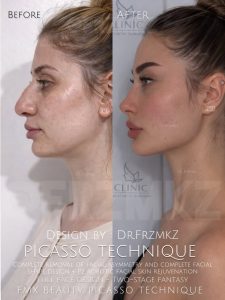
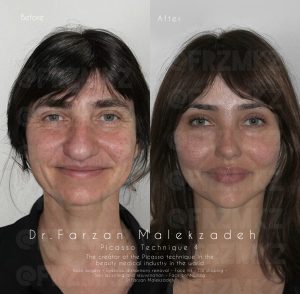
Educational Goals
The goal of this chapter is to provide a comprehensive understanding of the Picasso Technique (PT Technique) as a new paradigm and a complete biomedical life-design system for facial identity and biological vitality.
Learning Objectives
Upon completion of this chapter, the aesthetic medicine specialist will be able to:
• Define the concept of Biomedical Facial Architecture and Regenerative Life-Design;
• Understand how the Picasso Technique (PT Technique) fundamentally differs from static and trading-based aesthetic methodologies;
• Recognize the patient’s role as an active biological collaborator, accounting for approximately 50% of the final outcome and its impact on long-term stability.
Behavioral Objectives
By the end of this chapter, the specialist must be able to describe the Picasso Technique (PT Technique) in a 5-minute scientific presentation to peers, identify and explain at least three key differences from conventional methods with clinical examples, and prepare a one-page summary of the new biomedical paradigm.
Abstract
Background: Contemporary aesthetic medicine is predominantly structured around static procedural templates and commercially driven protocols. These approaches often neglect biological individuality, metabolic dynamics, psychological architecture, and long-term regenerative coherence.
The Picasso Technique (PT Technique) is introduced as a biomedical life-design system that surpasses conventional cosmetic paradigms by integrating regenerative medicine, anatomical facial design, metabolic conditioning, psychology, and multidisciplinary clinical execution.
Objective: To define the scientific positioning of the Picasso Technique as a dynamic, patient-centered, and biologically coherent medical system, and to differentiate it from trading-based and static aesthetic methodologies.
Results: The system demonstrates superior biological coherence, long-term structural stability, and psychologically congruent aesthetic outcomes when compared with static and trading-based aesthetic protocols. The integration of metabolic conditioning and psychological reorientation contributes to improved systemic health markers, enhanced regenerative capacity, and deceleration of degenerative aging processes. Patient participation constitutes approximately 50% of outcome optimization, thereby confirming the PT Technique as a co-created biomedical process rather than a passive service.
Conclusion: ThePicasso Technique represents a paradigm shift from cosmetic intervention toward biomedical life-design. By aligning regenerative biology, anatomical engineering, psychological resilience, and multidisciplinary teamwork, the method establishes a new scientific framework for sustainable aesthetic medicine and long-term biological vitality.
Final Conclusion & Scientific Statement
The Picasso Technique must be understood not as a single procedure, but as a systemic biomedical architecture for human facial identity and biological vitality. It integrates medical science, regenerative biology, psychology, metabolic engineering, and anatomical design into a unified therapeutic ecosystem.
Unlike conventional aesthetic methods that impose static forms upon heterogeneous human biology, the Picasso Technique reads the individual as a living system and reconstructs facial architecture in biological harmony with metabolism, vascular dynamics, neuromuscular expression, and psychological embodiment.
The method redefines the role of the patient from a passive recipient to an active biological collaborator. Approximately half of the final outcome depends on the patient’s adherence to nutritional protocols, psychological recalibration, lifestyle restructuring, and long-term discipline. This co-creative model transforms aesthetic medicine into a form of regenerative life-design.
When comprehensively applied across structured intervals throughout the lifespan, the Picasso Technique functions as a regenerative recalibration strategy capable of sustaining biological coherence, preserving structural vitality, and decelerating degenerative aging processes. Its systemic influence on metabolic stability, regenerative capacity, and psychological orientation toward life engagement may contribute to meaningful extensions of functional biological youthfulness.
The Picasso Technique does not impose an artificial identity; rather, it reveals the most biologically coherent expression of the patient’s innate facial identity.
In this sense, the Picasso Technique establishes a new scientific category: Biomedical Facial Architecture and Regenerative Life-Design.
Additional Scientific Note This system demonstrates strong conceptual alignment with the principles of regenerative biology and systems biology, viewing the face not as an isolated cosmetic target but as an integrated biological subsystem whose optimization can positively influence broader physiological and psychological homeostasis.
What Is the Picasso Technique (PT Technique)?
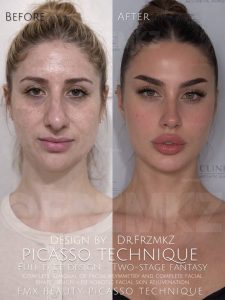
The original name of the method known today as the Picasso Technique is Picasso Technique. This term refers to a comprehensive facial design methodology based on precise point-based structural modification of the entire face.
The core objective of the Picasso Technique is to guide the face toward its most natural, balanced, and “virgin” structural state — a condition in which the face appears harmonious, youthful, and naturally aligned with its original anatomical identity rather than artificially altered.
Developed by Farzan Malekzadeh, the Picasso Technique represents a shift from traditional aesthetic procedures toward a systematic design approach in which every medical tool and intervention is defined within a broader architectural understanding of the face.
In this philosophy, aesthetic medicine is not simply about correction or augmentation. Instead, it is about designing the face through strategic intervention points that influence the entire facial structure.
Picasso Technique as Facial Architecture
In essence, the Picasso Technique can be described as:
A medical-artistic system for designing the human face through precise intervention in key structural points, guided by anatomical science, regenerative medicine, and visual balance.
It is a methodology where the practitioner acts not only as a surgeon or injector, but as a facial architect capable of understanding how small structural changes influence the entire composition of the face.
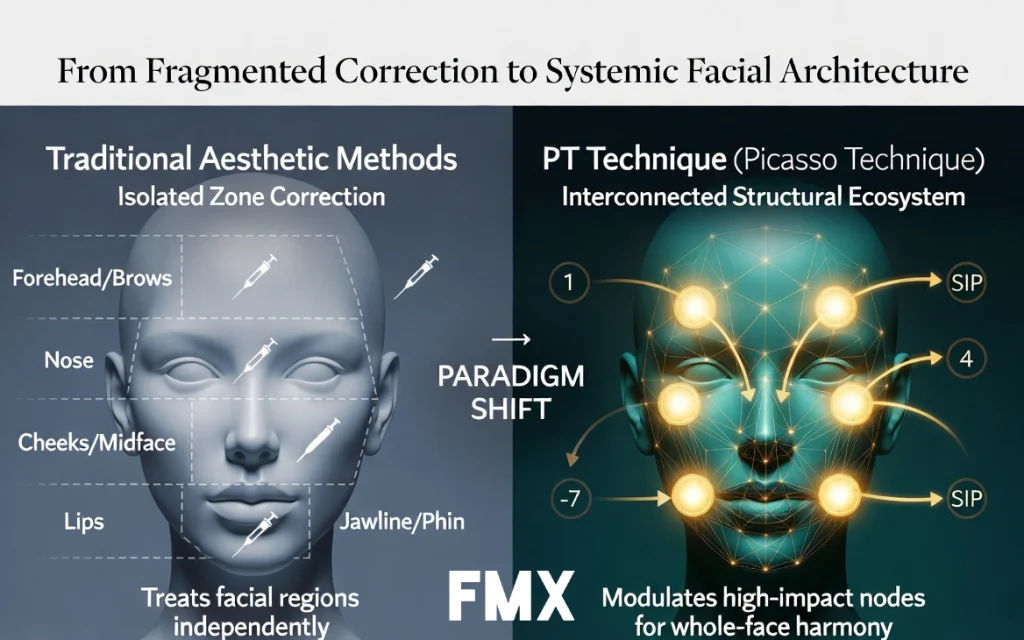
Figure 1.1. Conceptual comparison between traditional aesthetic methodologies and the Picasso Technique (PT Technique). Traditional methods treat facial regions as isolated zones (left), whereas the PT Technique views the face as an interconnected structural ecosystem in which modification of key Structural Influence Points (SIP) produces global harmonious transformation (right).
The Evolution of a New Aesthetic Philosophy
The Picasso Technique represents more than a procedural method; it reflects a broader shift in aesthetic medicine—moving toward a synthesis of:
• Science • Regenerative biology • Technology • Artistic anatomical understanding
In this model, the practitioner is not only a surgeon or injector but also a facial architect capable of understanding structure, emotion, and visual balance simultaneously.
In simple terms, traditional aesthetic procedures modify parts of the face. The Picasso Technique redesigns the entire facial harmony.
Clinical Pearls & Pitfalls
- Pearl: Always present the Picasso Technique to patients and colleagues as a “biomedical life-design system” rather than a cosmetic procedure; this single framing dramatically increases patient commitment and long-term adherence.
- Pearl: Emphasize from the first consultation that the patient is responsible for approximately 50% of the final outcome — this sets realistic expectations and filters out non-compliant candidates early.
- Pitfall: Describing the technique as “just another advanced filler or lifting method” destroys its scientific identity and leads to patients expecting immediate, one-session results.
- Pearl: Use the phrase “We do not add a new face — we reveal the most coherent biological version of your existing identity” in every initial consultation.
References Philipp-Dormston WG, et al. (2024). The Patient Journey in Facial Aesthetics: The Role of Active Patient Participation in Long-Term Outcomes. Journal of Cosmetic Dermatology, PMC10847668.