Educational Goals
The goal of this chapter is to develop a deep understanding of the scientific foundations of the Picasso Technique as a dynamic structural ecosystem rather than a collection of isolated interventions.
Learning Objectives
Upon completion of this chapter, the aesthetic medicine specialist will be able to:
• Explain the three core principles — Structural Influence Points (SIP), Viscosity-Based Tissue Response, and Regenerative Activation — and their role in full-face structural redesign;
• Describe the concept of Point-Based Full-Face Design and how minimal changes can produce comprehensive facial transformation;
• Analyze the philosophical and scientific differences between the Picasso Technique and traditional contouring or static aesthetic approaches.
Behavioral Objectives
By the end of this chapter, the specialist must be able to draw a conceptual map of the three scientific principles, provide at least two clinical examples demonstrating the effect of SIP across multiple facial zones, and explain the biological superiority of the Picasso Technique over a conventional protocol in a case discussion.
Scientific Foundations of the Picasso Technique
The Picasso Technique conceptualizes the face as a dynamic structural ecosystem rather than a collection of isolated anatomical regions, thereby enabling global structural harmony. Traditional aesthetic procedures often address localized concerns—such as the nose, jawline, or lips—while the Picasso methodology focuses on global structural harmony.
The scientific model behind the technique integrates three core principles:
- Structural Influence Points (SIP) Certain anatomical points within the facial architecture have disproportionate influence over symmetry, contour, and expression. Adjustments in these regions can affect multiple facial zones simultaneously.
- Viscosity-Based Tissue Response Different viscosities of injectable or biological materials interact uniquely with muscular layers, subcutaneous fat, and connective tissue networks. Understanding these interactions allows controlled remodeling of facial structure.
- Regenerative Activation Biological components such as plasma-derived materials and cellular stimulation methods are used to encourage tissue renewal rather than simple volume replacement.
Biophysical Mechanism of Viscosity-Based Tissue Response
The interaction of injectable materials with facial tissues is governed by principles of tissue rheology. Higher-viscosity agents provide structural support in deeper layers, while lower-viscosity formulations allow precise diffusion in superficial planes, enabling controlled remodeling without compromising natural tissue dynamics.
Collectively, these three principles represent a paradigm transition from localized corrective interventions to comprehensive structural redesign.
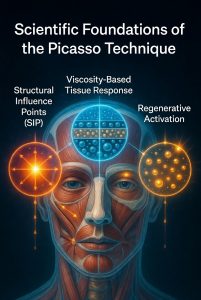
Figure 2.1. Infographic summary of the three core scientific principles of the Picasso Technique, illustrating their interconnected role in full-face structural redesign and the cascade effect of a single Structural Influence Point (SIP).
The Core Principle: Point-Based Full-Face Design
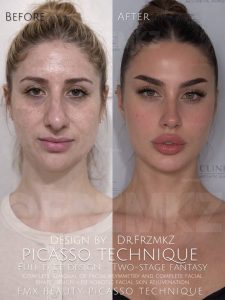
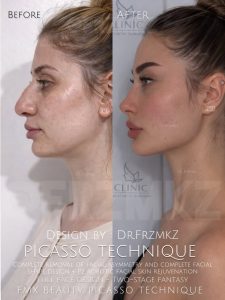
At the center of the Picasso Technique lies a fundamental concept: Small modifications in highly sensitive facial points can lead to significant structural transformation across the entire face.
Unlike traditional procedures such as rhinoplasty or localized filler treatments, which often focus on individual areas, the Picasso Technique treats the face as an interconnected anatomical and visual system.
Why the Picasso Technique Is Different from Traditional Aesthetic Methods
The Picasso Technique represents a fundamental shift in the philosophy of aesthetic medicine. While traditional aesthetic procedures are typically focused on correcting individual facial areas, the Picasso Technique approaches the face as a complete structural and visual system.
Most conventional methods are designed to improve a specific feature — for example the nose, jawline, lips, or skin surface. These approaches often achieve localized improvement, but they do not always consider how each facial element interacts with the rest of the face.
The Picasso Technique is different because it is based on full-face intelligence and structural balance. Instead of treating isolated areas, the technique analyzes the entire facial architecture, including:
• Bone structure • Soft tissue dynamics • Facial expressions • Proportions between facial elements • Light reflection and visual balance
This allows the practitioner to design changes that affect the overall harmony of the face rather than producing separate modifications.
Another major difference is that traditional aesthetic procedures usually follow standardized treatment patterns. In many cases, similar injection points or surgical approaches are used for a wide range of patients. The Picasso Technique does the opposite. It is based on individual facial mapping, meaning that every face is studied and designed differently according to its unique structure, emotional expression, and natural identity.
In this methodology, the practitioner studies:
• Sensitive structural points of the face • Tissue response to intervention • The reaction of muscles and skin layers • The way the human eye perceives balance and beauty
This level of analysis allows changes that can range from subtle refinements to significant facial transformation.
One of the most important distinctions of the Picasso Technique is its ability to work across multiple anatomical layers simultaneously. Traditional approaches often operate on a single level — either surgical correction, fillers, or skin treatments. The Picasso Technique integrates different levels of intervention, including:
• Structural adjustment of facial points • Regenerative stimulation • Precision injector techniques • Advanced aesthetic design principles
Because of this integration, the results often appear more natural and balanced, rather than artificial or exaggerated.
Another critical factor is the role of visual perception. Historically, aesthetic medicine focused mainly on anatomical correction and medical safety. While these remain essential, the Picasso Technique adds an additional dimension — understanding how beauty is perceived through light, symmetry, and facial flow. This includes analyzing:
• How light moves across the face • How the eyes naturally observe facial features • How proportions influence attractiveness • How minimal changes can reshape the overall appearance
For this reason, the Picasso Technique is often described not only as a medical method, but also as a form of facial architecture and artistic science.
Beyond Traditional Contouring
Although modern aesthetic medicine widely uses the term “contouring,” the Picasso Technique goes significantly further. Rather than adding volume to predefined areas such as the jawline or cheekbones, the method focuses on:
• Structural alignment of the entire face • Multi-layer anatomical adjustment • Coordinated changes between facial zones • Restoration of natural identity rather than artificial shaping
This approach allows the technique to create transformations that may range from minor refinements to profound facial rejuvenation.
A New Perspective in Aesthetic Medicine
Historically, many surgical procedures focused primarily on:
• Medical safety • Technical success of the operation • Structural correction of isolated areas
While these factors remain essential, earlier approaches often overlooked how the human eye perceives beauty as a complete system. The Picasso Technique introduced an additional dimension rarely considered before: visual perception and light dynamics on the face. This includes:
• How the eye naturally scans a face • How shadows and light reflections shape perceived beauty • How facial proportions interact under different lighting conditions • How subtle adjustments can enhance natural harmony
In this methodology, beauty is not only anatomical — it is also optical, psychological, and artistic.
Clinical Pearls & Pitfalls
Clinical Pearls & Pitfalls
- Pearl: The most powerful transformations occur when less than 15% of strategic facial points are modified. Over-treating multiple zones simultaneously is the most common mistake even among experienced injectors.
- Pearl: Different tissue viscosities are not interchangeable. Selecting the precise viscosity for each anatomical layer (guided by tissue rheology) is more important than the brand or type of material.
- Pitfall: Treating the face as a collection of separate aesthetic units (cheeks, jaw, nose, etc.) instead of a single interconnected system inevitably leads to disharmony and unnatural results.
- Pearl: Before any intervention, mentally map how modification of one SIP will cascade across at least three distant facial zones.
References Crowley J, et al. (2021). Regenerative and stem cell-based techniques for facial rejuvenation: A systematic review. Aesthetic Surgery Journal, PMC8381699..