Educational Goals
The goal of this chapter is to familiarize the reader with anatomical mapping and the identification of high-impact anatomical nodes (sensitive facial points) within the Picasso Technique.
Learning Objectives
Upon completion of this chapter, the aesthetic medicine specialist will be able to:
• Identify key sensitive facial points and understand their influence on facial balance, symmetry, light reflection, expression, and perceived vitality;
• Explain the chain-reaction mechanism across muscular, soft tissue, and dermal layers following intervention;
• Comprehend the principle of 10% change and its role in achieving maximum aesthetic leverage with minimal intervention.
Behavioral Objectives
By the end of this chapter, the specialist must be able to create a simplified anatomical map of a hypothetical patient’s face, mark at least five sensitive structural points, and write a case report describing the impact of modifying a single point on the entire face, including an approximate percentage of change and reference to chapter principles.
Anatomical Mapping and Sensitive Facial Points
One of the distinguishing features of the Picasso Technique is the identification of what are described as high-impact anatomical nodes within the face. These points include regions that influence:
• Facial balance • Symmetry of expressions • Skin tension distribution • Perceived age and vitality • Light reflection and facial geometry
Research and clinical observation indicated that modifying a relatively small percentage of these points can produce a full-face transformation while preserving natural identity. This approach reduces unnecessary interventions and focuses treatment on areas that provide maximum aesthetic leverage.
The Importance of Sensitive Facial Points
One of the most defining aspects of the Picasso Technique is the recognition of sensitive facial points and their reactions. The face is not static. Every intervention creates a chain reaction across muscles, tissues, and expressions.
The Picasso Technique studies these reactions carefully:
• How tissues respond to pressure, volume, and placement • How facial muscles interact with injected or regenerative materials • How structural adjustments influence the balance of the entire face
This understanding allows the practitioner to work with the face rather than against it.
Through detailed mapping of facial anatomy, practitioners identify key structural nodes that influence:
• Facial symmetry • Balance between eyes, nose, lips, and jawline • Light reflection across facial surfaces • Perceived age and vitality • Emotional expression and facial dynamics
By adjusting these points across multiple anatomical layers — including skeletal structure, soft tissue, and skin dynamics — the technique can produce transformations ranging from subtle refinement (around 10% change) to significant structural enhancement.
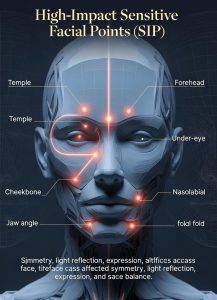
Figure 3.1. Anatomical mapping diagram showing high-impact sensitive facial points (SIP) and their global cascade effect across multiple facial zones in the Picasso Technique.
Clinical Pearls & Pitfalls
- Pearl: The real artistry lies in finding the exact “trigger points” that control global facial geometry. These points differ subtly between genetic backgrounds and must be individually mapped for each patient.
- Pearl: A well-chosen single point modification can improve overall facial harmony by 10–15% with almost no visible local change — this is the true essence of the Picasso Technique.
- Pitfall: Injecting or modifying points based on standard textbooks or “average” anatomy rather than the patient’s unique facial ecosystem almost always results in suboptimal or artificial-looking outcomes.
- Pearl: Spend at least 20–30 minutes on live anatomical mapping and dynamic expression analysis before any intervention.