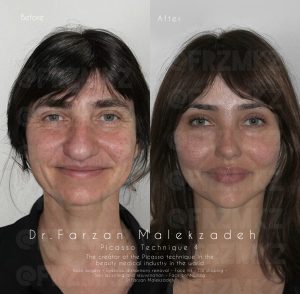
Educational Goals
The goal of this chapter is to establish a clear understanding of the safety framework, ethical boundaries, and clinical indications of the PT Technique (Picasso Technique).
Learning Objectives
Upon completion of this chapter, the aesthetic medicine specialist will be able to: • Identify the precise medical indications and contraindications for the Picasso Technique; • Describe the multi-layered safety framework and the scientific process of informed consent; • Understand the principle of Minimal Effective Design (MED) and the ethical boundaries designed to prevent aesthetic violence.
Behavioral Objectives
By the end of this chapter, the specialist must be able to complete a full informed consent form for a hypothetical patient, list at least three indications and three contraindications, and justify a clinical decision in an ethical scenario based on the Minimal Effective Design (MED) principle.
Clinical Indications, Safety Framework, and Ethical Boundaries of PT Technique (Picasso Technique)
1. Clinical Indications: When PT Technique Is Medically Justified
PT Technique (Picasso Technique) is not indicated for indiscriminate aesthetic alteration. It is clinically justified only when there is a clear, evidence-based rationale grounded in anatomical, functional, regenerative, or psychosocial considerations.
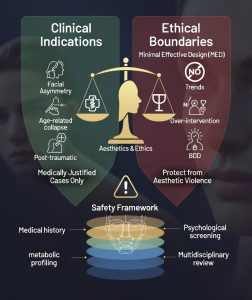
Primary indications include: • Congenital or developmental facial asymmetries • Post-traumatic facial structural distortions • Age-related structural collapse and tissue deflation • Post-surgical aesthetic or functional imbalance • Dysmorphology secondary to disease, inflammation, or metabolic disorders • Patients with high aesthetic demands requiring biologically coherent, natural outcomes
PT Technique is not a cosmetic trend intervention; it is a medically designed aesthetic-reconstructive protocol.
2. Safety Framework: Multilayered Risk Control
Safety within PT Technique (Picasso Technique) is not procedural—it is systemic. The safety framework is built upon:
• Comprehensive medical history and risk stratification • Metabolic, hormonal, and inflammatory profiling • Vascular mapping and anatomical risk zoning • Psychological screening to rule out body dysmorphic disorder (BDD) and related conditions • Multidisciplinary case review before any intervention • Stepwise intervention with real-time biological monitoring
Each phase is reversible in planning, conservative in execution, and progressive in outcome evaluation. The protocol is intentionally staged to prevent irreversible complications.
3. Ethical Boundaries: Medical Integrity over Aesthetic Extremes
PT Technique (Picasso Technique) is ethically bounded by medical responsibility. Explicit ethical limits include:
• Refusal of interventions that distort natural human proportions beyond biological coherence • Rejection of procedures driven by social media trends, filters, or unrealistic beauty standards • Absolute contraindication in patients with untreated psychological instability related to self-image • Prohibition of procedures that compromise functional anatomy for visual exaggeration • Full transparency regarding limitations, risks, timelines, and achievable outcomes
The technique is designed to protect the patient from aesthetic violence, not to participate in it.
4. Informed Consent as a Scientific Process
In PT Technique (Picasso Technique), informed consent is not a legal formality; it is an educational process. Patients are systematically educated about:
• The biological logic of the protocol • The staged nature of outcomes • The non-instantaneous timeline of regeneration • The limitations of anatomical change • The long-term responsibilities of post-procedural care
Consent is only considered valid when the patient demonstrates comprehension of biological, psychological, and temporal implications.
5. Risk of Over-Intervention and the Principle of Minimal Effective Design
Picasso Technique follows the principle of Minimal Effective Design (MED): Only the minimum necessary intervention required to achieve biological coherence is ethically permissible. Any additional manipulation beyond this threshold is considered aesthetic excess and is rejected within the Picasso Technique framework.
6. Accountability and Traceability
All PT Technique (Picasso Technique) protocols are fully documented: • Pre-intervention anatomical mapping • Design schematics • Material selection rationale • Regenerative parameters • Outcome metrics and follow-up data
This creates traceable clinical accountability and enables longitudinal scientific evaluation.
7. Final Ethical Statement
PT Technique (Picasso Technique) operates at the intersection of medicine, design, and human dignity. The face is not a commercial canvas. It is a biological identity system. Any method that ignores this principle is not medicine—it is cosmetic trading.
Clinical Pearls & Pitfalls
- Pearl: The best way to protect your reputation and patient safety is to say “No” to requests that violate biological coherence or natural proportions.
- Pearl: Psychological screening for Body Dysmorphic Disorder (BDD) and unrealistic expectations is non-negotiable and must be performed by a qualified clinical psychologist within the team.
- Pitfall: Performing the technique on patients seeking “Instagram-face” or trend-driven changes almost always leads to regret, dissatisfaction, and reputational damage.
- Pearl: Informed consent in Picasso Technique is an educational process, not a legal document. The patient must clearly understand the 50% personal responsibility and the non-instantaneous regenerative timeline before any intervention.
- Pearl: Always adhere to Minimal Effective Design (MED) — doing less is almost always doing better.