Educational Goals
The goal of this chapter is to define the scientific position of the Picasso Technique (PT Technique) within regenerative medicine and its impact on biological longevity and active patient participation.
Learning Objectives
Upon completion of this chapter, the aesthetic medicine specialist will be able to: • Explain the 50% Principle of patient participation and its critical role in final outcomes; • Identify the systemic mechanisms that act as longevity catalysts (metabolic, psychological, and regenerative); • Analyze the fundamental philosophical and biological differences between the Picasso Technique and trading-based or static aesthetic methods.
Behavioral Objectives
By the end of this chapter, the specialist must be able to design a lifelong treatment strategy (4–5 applications across a lifetime) for a hypothetical patient, identify and explain at least five longevity catalyst factors, and prepare a 10-minute scientific presentation on the Picasso Technique as a “life-design medical system,” including a visual representation of the 50% patient participation principle
Scientific Positioning of Picasso Technique (PT Technique) in the Global Aesthetic Medicine Landscape and Its Impact on Biological Longevity, Patient Participation, and Systemic Health
PT Technique (Picasso Technique) occupies a distinct scientific position within global aesthetic and regenerative medicine. It cannot be categorized as a cosmetic method, nor as a conventional surgical protocol. It is a life-design medical system that integrates clinical medicine, regenerative biology, psychology, nutritional science, and architectural facial design into one coordinated therapeutic ecosystem.
1. Beyond Clinics: A Multi-Space Medical Ecosystem
PT Technique (Picasso Technique) is not confined to a single clinical environment. Its execution unfolds across multiple coordinated spaces:
• The clinic and hospital setting (clinical safety and intervention) • The procedure room (microsurgical and regenerative execution) • The design room (anatomical and structural facial architecture) • The thinking room of the multidisciplinary team (strategic medical planning) • The internal space of the patient (psychological readiness, discipline, and cooperation)
This distributed architecture transforms the intervention from a procedure into a systemic medical project.
2. The 50% Principle: Patient Participation as a Clinical Determinant
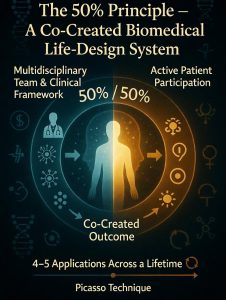
One of the most critical scientific differentiators of PT Technique (Picasso Technique) is that at least 50% of the final outcome is determined by the patient’s active participation. Clinical excellence alone is insufficient. The patient must actively engage in:
• Nutritional protocols • Psychological recalibration • Lifestyle restructuring • Adherence to metabolic conditioning • Long-term post-procedural discipline
Picasso Technique is therefore a co-created outcome. The medical team constructs the biological framework; the patient animates it through compliance, mindset, and continuity. Without this partnership, even the most advanced medical execution cannot reach its full biological potential.
3. Teamwork as a Longevity Catalyst
PT Technique (Picasso Technique) is fundamentally a teamwork-based medical system. The coordinated function of surgeons, dermatologists, psychologists, regenerative medicine specialists, designers, statisticians, and technologists creates a coherent therapeutic field. This teamwork does not merely optimize aesthetic outcomes. It reorganizes the patient’s biological and psychological environment in a manner that:
• Enhances systemic health • Reduces chronic inflammatory burden • Stabilizes metabolic regulation • Improves neuro-psychological resilience • Increases adherence to health-preserving behaviors
Collectively, these factors function as longevity catalysts.
4. Biological Longevity: Not a Claim, but a Systemic Consequence
The full execution of PT Technique (Picasso Technique), when completed comprehensively and ethically, may contribute to a measurable extension of biological vitality. In many cases, this systemic reorganization can translate into the equivalent of up to a decade of functional biological youthfulness, not merely aesthetic youth.
This is not a metaphysical claim. The scientific rationale is rooted in: • Sustained metabolic optimization • Regenerative tissue conditioning • Psychological reorientation toward life engagement • Chronic stress reduction • Behavioral redesign toward health-preserving routines
These factors collectively influence cellular aging pathways and systemic decline patterns. By redesigning the patient’s biological and psychological operating system, Picasso Technique reduces the velocity of degenerative processes.
5. Repetition Across a Lifetime: A Regenerative Life Strategy
It is not an unrealistic proposition that an individual may undergo PT Technique (Picasso Technique) four to five times across a lifetime, with appropriate intervals, maintenance protocols, nutritional systems, regenerative support, and lifestyle design. Across decades, this structured regenerative recalibration:
• Maintains structural coherence • Preserves tissue vitality • Reinforces psychological resilience • Continuously reorganizes biological efficiency
This life-strategy approach allows the individual to progressively access deeper levels of physiological balance and self-regulatory capacity. It is not merely facial redesign; it is iterative biological recalibration across the lifespan.
6. Regenerative Proteomic Reorganization (Conceptual Framework)
Within PT Technique (Picasso Technique), systemic regeneration influences not only tissue architecture but also protein-level functional renewal. Under sustained metabolic, nutritional, psychological, and regenerative conditioning, the organism enters a higher-order vitality state in which endogenous proteins and structural components exhibit enhanced renewal dynamics. This creates a self-reinforcing vital loop: a biologically supportive environment promotes regeneration, and regeneration further stabilizes the biological environment.
The mechanistic details of this vital regenerative loop will be elaborated in subsequent sections. At this stage, it is sufficient to state that Picasso Technique initiates a life-supportive systemic trajectory, rather than a single isolated intervention.
7. Final Scientific Positioning Statement
PT Technique (Picasso Technique) does not belong to the market of aesthetic services. It belongs to the emerging field of biomedical life-design systems. It reconstructs not only the face, but the patient’s biological rhythm, psychological orientation, and relationship with their own aging process.
This is why Picasso Technique is not a procedure to be “done.” It is a system to be lived.
Why Picasso Technique Is Fundamentally Different from Trading-Based or Static Aesthetic Methods
1. Dynamic Biological Architecture vs. Static Cosmetic Protocols Conventional aesthetic medicine largely operates on static protocols. These protocols are built upon pre-designed templates: fixed injection points, standardized filler volumes, repetitive lifting vectors, and uniform procedural sequences. Such methods treat the human face as a static surface rather than a dynamic biological system.
PT Technique (Picasso Technique), in contrast, is based on dynamic biological architecture. The human face is understood as a living, adaptive system governed by metabolism, vascular flow, neuromuscular feedback, regenerative capacity, and psychological expression. Therefore, no two protocols can be identical, even in patients with superficially similar facial morphology.
Static methods aim to apply beauty. Picasso Technique aims to reconstruct biological harmony.
2. Trading Logic vs. Medical-System Logic Many global aesthetic approaches function on a trading model: • Fixed packages • Predefined procedure lists • Standardized pricing and volumes • Commercially driven protocol repetition
This trading logic prioritizes scalability and profitability over biological individuality. The patient becomes a category, not a system.
PT Technique (Picasso Technique) follows medical-system logic, not trading logic. Each protocol is: • Individually designed • Biologically conditioned • Anatomically engineered • Temporally scheduled • Multidisciplinarily executed
There is no concept of “one package fits all” within Picasso Technique. Each face represents a unique biomedical project.
3. Algorithmic Templates vs. Clinical Intelligence Static aesthetic methods rely on algorithmic templates: fixed angles, predefined points, and repeated vectors. This creates procedural uniformity but sacrifices biological precision.
PT Technique (Picasso Technique) replaces templates with clinical intelligence. Decision-making is continuously adjusted in real time based on: • Tissue feedback • Vascular response • Cellular regeneration dynamics • Patient-specific metabolic reactions • Neuro-muscular expression patterns
The practitioner does not follow a script; the practitioner reads a living biological system.
4. Product-Centered Practice vs. System-Centered Medicine In trading-based aesthetics, the method often revolves around products: one brand of filler, one type of plasma device, one surgical instrument line.
PT Technique (Picasso Technique) is system-centered, not product-centered. Materials, viscosities, regenerative agents, and devices are selected, formulated, or customized only after anatomical and biological assessment. No product defines the method; the biological system of the patient defines the tools.
5. Short-Term Visual Effect vs. Long-Term Biological Coherence Static aesthetic methods are primarily outcome-driven toward immediate visual effect. Longevity and biological integration are secondary.
PT Technique (Picasso Technique) is designed for long-term biological coherence: • Harmonization with natural aging • Structural stability over time • Regenerative tissue adaptation • Psychologically congruent self-perception
The objective is not temporary visual satisfaction, but sustainable anatomical harmony.
6. Reproducibility of Procedures vs. Irreproducibility of Human Biology Trading-based systems depend on reproducibility. Human biology is fundamentally irreproducible.
PT Technique (Picasso Technique) acknowledges that: • Genetic variability • Metabolic uniqueness • Structural diversity • Psychological embodiment
make standardized repetition biologically invalid. The method adapts to the patient; the patient does not adapt to the method.
7. Philosophical Distinction Static aesthetic methods attempt to impose form. PT Technique (Picasso Technique) seeks to reveal biological form.
This distinction places Picasso Technique not merely within aesthetic medicine, but within biomedical design philosophy.
Clinical Pearls & Pitfalls
- Pearl: The 50% Principle is not motivational rhetoric — it is a clinical reality. Outcomes are dramatically superior when patients fully commit to nutritional, psychological, and lifestyle protocols.
- Pearl: Frame the Picasso Technique as a lifelong regenerative strategy rather than a one-time procedure. Patients who understand this concept show significantly higher compliance and better long-term results.
- Pitfall: Underestimating the importance of continuous metabolic and psychological support after the clinical phases leads to gradual loss of structural gains within 2–3 years.
- Pearl: Patients who undergo the full protocol 4–5 times across their lifetime, with proper intervals and maintenance, can achieve the biological equivalent of delaying visible and functional aging by up to a decade.
- Pearl: The ultimate goal is not to make the patient look younger, but to help them remain biologically coherent and vital for as long as possible.