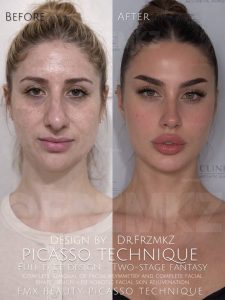
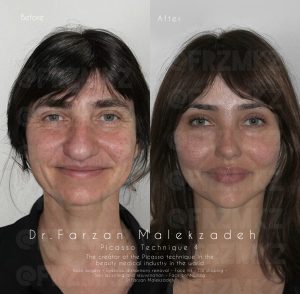
About Picasso Technique
From adversity emerged vision; a physician transformed art into science, pioneering the Picasso Technique through regenerative facial innovation.
From Despair to Discovery: The Miraculous Birth of the Picasso Technique
The Picasso Technique was born in 2007 at a critical turning point, when conventional aesthetic methods failed to address facial asymmetry, tissue damage, and unpredictable outcomes. This led to a new understanding of the face as a dynamic biomechanical system, not just a surface for correction. Based on this shift, a structured, point-based, and regenerative approach was developed—forming the foundation of the Picasso Technique as a system for true anatomical restoration and long-term harmony, rather than temporary enhancement.

Don't worry!
You are already beautiful.
It’s just that not everyone has the eyes to recognize your light. Trust yourself, your beauty was never meant for ordinary vision.”
Creator of Picasso Technique


The 2007 Origin Story
From Mud Statue to Picasso Technique
The Origin of the Picasso Technique: From 2007 Early Inspiration to Defining Revelation in 2014
Although the Picasso Technique was formally established and gained momentum in 2014, its conceptual origin dates back to 2007, when an early vision emerged: challenging the impossible to redefine the beautiful.
At that time, Dr. Farzan Malekzadeh introduced a radical idea—combining facial contouring with stem cells and conditioned media. Despite being met with skepticism and rejection, this regenerative and structural perspective laid the intellectual foundation for what would later evolve into a transformative system in aesthetic medicine.
In 2014, during a period of profound personal hardship, this vision reached a defining moment. Stranded for days in an abandoned mining environment, Dr. Malekzadeh, in a state of exhaustion and reflection, sculpted a human face from mud, placing his mother’s cross necklace upon it—symbolizing memory, identity, and restoration. Following this moment, he was discovered and referred to as “a Picasso”, an encounter that marked the symbolic naming of the technique.
This pivotal experience transformed earlier theoretical insights into a practical and experimental pathway. Within the same year, the first applications combining conditioned media with facial structural design were initiated, marking the birth of the Picasso Technique as a structured, regenerative, and point-based system.
Thus, the Picasso Technique represents not a sudden invention, but the convergence of a long-term intellectual evolution (since 2007) and a defining moment of realization (2014)—establishing a methodology aimed at true anatomical restoration, biological regeneration, and long-term facial harmony.
Farzan Malekzadeh
From Despair to Inspiration
While the foundations of the Picasso Technique began in 2007, its defining moment occurred in 2014, when Dr. Farzan Malekzadeh, during a period of profound hardship, sculpted a symbolic face from earth and placed his mother’s cross necklace upon it—an act that transformed earlier ideas into a revolutionary regenerative facial design concept.
A Name Born in Moonlight
Rescued by a woman named Medusa, who saw his creation under moonlight and laughed, “You are a Picasso for yourself!” — this was the first time Dr. Malekzadeh heard the name Picasso. That single phrase ignited his vision to transform artistic intuition into medical innovation on human faces.
From Mud to Mastery
Guided by Medusa’s constant support, Dr. Malekzadeh began experiments that same year, applying conditioned media to her face and officially naming it the Picasso Technique — a fusion of personal revelation, scientific rigor, and regenerative artistry that redefines aesthetic medicine.