Long-Term Facial Reconstruction Using the Picasso Technique: Correction of Structural Errors, Asymmetry, and Tissue Damage Through Biomedical Facial Architecture
Description
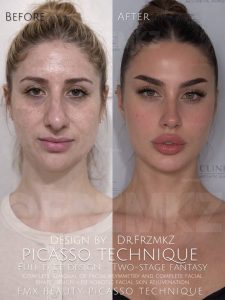
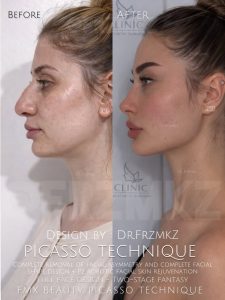
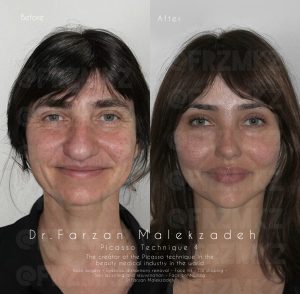
This case represents a long-term biomedical facial reconstruction using the Picasso Technique (PT Technique), emphasizing correction of previous structural and iatrogenic aesthetic errors rather than simple enhancement (Chapter 1, Chapter 5).
Performed Interventions (Bold as requested):
- Facial asymmetry correction
- Correction of incorrect filler complications
- Fibrosis and tissue damage repair
- Volume misplacement correction (redistribution)
- Ligament support restoration
- Correction of poor previous aesthetic outcomes
Scientific Interpretation Based on Picasso Technique Framework
1. Reconstruction vs Enhancement
Unlike conventional aesthetic procedures focused on augmentation, this case demonstrates a reconstructive approach, addressing:
- Structural imbalance
- Tissue pathology (fibrosis)
- Iatrogenic complications
This aligns with the indication framework of Picasso Technique, where treatment is medically justified, not trend-driven (Chapter 5).
2. Structural Influence Points (SIP) in Correction
The correction of asymmetry and volume misplacement was likely achieved through targeting high-impact Structural Influence Points (SIP), allowing:
- Redistribution of tension
- Rebalancing of facial geometry
- Global improvement from minimal intervention
(Chapter 2, Chapter 3)
3. Management of Filler Complications & Fibrosis
The presence of:
- Incorrect filler placement
- Fibrotic tissue
requires a multilayer intervention strategy, including:
- Structural recalibration
- Tissue remodeling
- Regenerative activation
This reflects the transition from product-based aesthetics to system-based medicine (Chapter 2, Chapter 4).
4. Ligament Support Restoration
Weak ligament structures contribute to:
- Facial sagging
- Loss of structural definition
- Aging patterns
Restoration of ligament support indicates deep-layer intervention consistent with biomechanical facial architecture design (Chapter 4).
5. Gradual Transformation (Temporal Architecture)
The emphasis on gradual correction highlights:
- Biological adaptation
- Tissue response kinetics
- Regenerative remodeling
This is a core principle of Picasso Technique, where outcomes are time-dependent and biologically individualized, not immediate (Chapter 4, Chapter 6).
6. Correction of Previous Aesthetic Errors
This case strongly demonstrates one of the most critical roles of Picasso Technique:
- Converting disharmonious, artificial, or failed results into biologically coherent structures
This reflects:
- Rejection of standardized protocols
- Individual facial mapping
- System-based redesign
(Chapter 2, Chapter 5)
7. System-Based Medical Design
The case embodies the concept that:
“This is medical facial design, not trends.”
Meaning:
- No template-based injection
- No commercial protocol repetition
- Full reliance on anatomical, biomechanical, and regenerative logic
(Chapter 1, Chapter 6)
Conclusion (Scientific Framing)
This case demonstrates that the Picasso Technique is not merely an aesthetic tool, but a corrective and reconstructive biomedical system capable of:
- Reversing complications from previous interventions
- Restoring structural integrity
- Rebuilding facial harmony through minimal yet strategic intervention
It confirms the role of Picasso Technique as:
- A system for biological correction, not cosmetic enhancement
- A method for restoring identity, not creating artificial appearance