


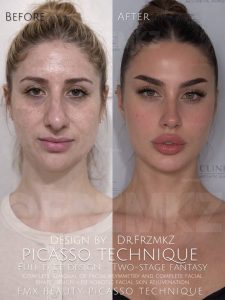
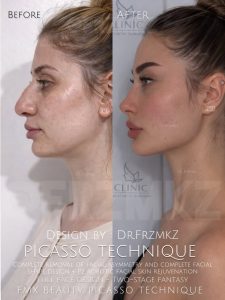
Description
This case represents a long-term biomedical facial reconstruction using the Picasso Technique (PT Technique), emphasizing correction of previous structural and iatrogenic aesthetic errors rather than simple enhancement (Chapter 1, Chapter 5).
Performed Interventions (Bold as requested):
Scientific Interpretation Based on Picasso Technique Framework
1. Reconstruction vs Enhancement
Unlike conventional aesthetic procedures focused on augmentation, this case demonstrates a reconstructive approach, addressing:
This aligns with the indication framework of Picasso Technique, where treatment is medically justified, not trend-driven (Chapter 5).
2. Structural Influence Points (SIP) in Correction
The correction of asymmetry and volume misplacement was likely achieved through targeting high-impact Structural Influence Points (SIP), allowing:
(Chapter 2, Chapter 3)
3. Management of Filler Complications & Fibrosis
The presence of:
requires a multilayer intervention strategy, including:
This reflects the transition from product-based aesthetics to system-based medicine (Chapter 2, Chapter 4).
4. Ligament Support Restoration
Weak ligament structures contribute to:
Restoration of ligament support indicates deep-layer intervention consistent with biomechanical facial architecture design (Chapter 4).
5. Gradual Transformation (Temporal Architecture)
The emphasis on gradual correction highlights:
This is a core principle of Picasso Technique, where outcomes are time-dependent and biologically individualized, not immediate (Chapter 4, Chapter 6).
6. Correction of Previous Aesthetic Errors
This case strongly demonstrates one of the most critical roles of Picasso Technique:
This reflects:
(Chapter 2, Chapter 5)
7. System-Based Medical Design
The case embodies the concept that:
“This is medical facial design, not trends.”
Meaning:
(Chapter 1, Chapter 6)
Conclusion (Scientific Framing)
This case demonstrates that the Picasso Technique is not merely an aesthetic tool, but a corrective and reconstructive biomedical system capable of:
It confirms the role of Picasso Technique as:

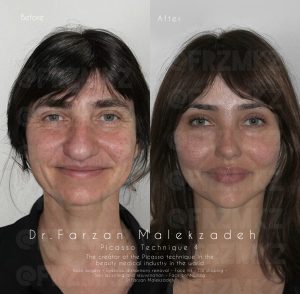
Description
In this case, a comprehensive full-face architectural transformation was performed using the Picasso Technique (PT Technique) as a biomedical life-design system, rather than a conventional aesthetic intervention (Chapter 1).
Performed Interventions (Bold as requested):
Micro-surgery full face
Eyebrow disharmony removal
Face lift (structural)
Lip shaping (architectural)
Skin recycling and rejuvenation (regenerative activation)
Face contouring (full-face design)
P2 device-assisted intervention
Scientific Interpretation Based on Picasso Technique Framework
1. Full-Face Structural Approach vs Local Treatment
Unlike traditional methods that treat isolated areas, this case demonstrates a Point-Based Full-Face Design, where minimal interventions at key nodes resulted in global harmony (Chapter 2).
The correction of eyebrow disharmony alone likely influenced:
Periorbital balance
Upper facial tension distribution
Visual symmetry and emotional expression
This reflects the principle of Structural Influence Points (SIP) (Chapter 2, Chapter 3).
2. Multilayer Intervention Strategy
The integration of:
Micro-surgery
Regenerative skin recycling
Lip shaping
Contour redesign
indicates execution across multiple anatomical layers:
Skeletal alignment
Soft tissue modulation
Dermal regeneration
This aligns with the four-phase clinical execution model of Picasso Technique (Chapter 4).
3. Regenerative Activation & Skin Recycling
The skin rejuvenation component represents Regenerative Activation, where tissue renewal is stimulated instead of simple volume replacement (Chapter 2).
This contributes to:
Improved skin vitality
Enhanced cellular turnover
Long-term biological coherence
4. Role of Device Integration (P2 Device)
The use of P2 device reflects the concept of multidisciplinary and technological integration, where tools are selected based on biological need rather than standardized protocols (Chapter 4).
5. Hand Art & Final Calibration
Although not explicitly stated, the final outcome strongly suggests the application of Hand Art (manual intelligence), which is critical for:
Micro-adjustments
Tissue response interpretation
Natural final appearance
(Chapter 4)
6. Temporal Architecture (86 Days)
The 86-day transformation timeline falls within the biologically expected window of Picasso Technique outcomes, reflecting:
Individual metabolic response
Regenerative capacity
Tissue remodeling kinetics
(Chapter 4 – Individualized Treatment Timing)
7. Outcome: Biological Coherence, Not Artificial Change
The final result represents:
Preservation of identity
Structural harmony
Natural rejuvenation
This directly reflects the core philosophy:
“The technique does not add a new face — it reveals the most biologically coherent version of the existing identity.”
(Chapter 1)
Conclusion (Scientific Framing)
This case exemplifies the transition from cosmetic intervention to biomedical facial architecture, where:
Less than full-face aggressive treatment
Strategic point-based modification
Regenerative support
led to a high-impact, natural transformation.
It confirms that the Picasso Technique operates as:
A dynamic, patient-specific, regenerative life-design system
rather than a static aesthetic procedure
(Chapter 1, Chapter 6)
